
Every FHE tutorial mentions noise. Almost none of them explain it intuitively enough to be useful.
This article fixes that. We're going to explain noise accumulation, relinearization, and bootstrapping with analogies and visuals and then show how Aura's specific implementation manages this for low-latency DeFi.
The Noise Analogy: Static on a Photograph
When you encrypt a value under FHE, you're not just locking it in a box. You're wrapping it in a layer of mathematical randomness — "noise" — that makes the ciphertext indistinguishable from random data without the private key.
This noise is intentional. Without it, the encryption would be trivially breakable.
But here's the engineering challenge: every operation you perform on the ciphertext adds more noise.
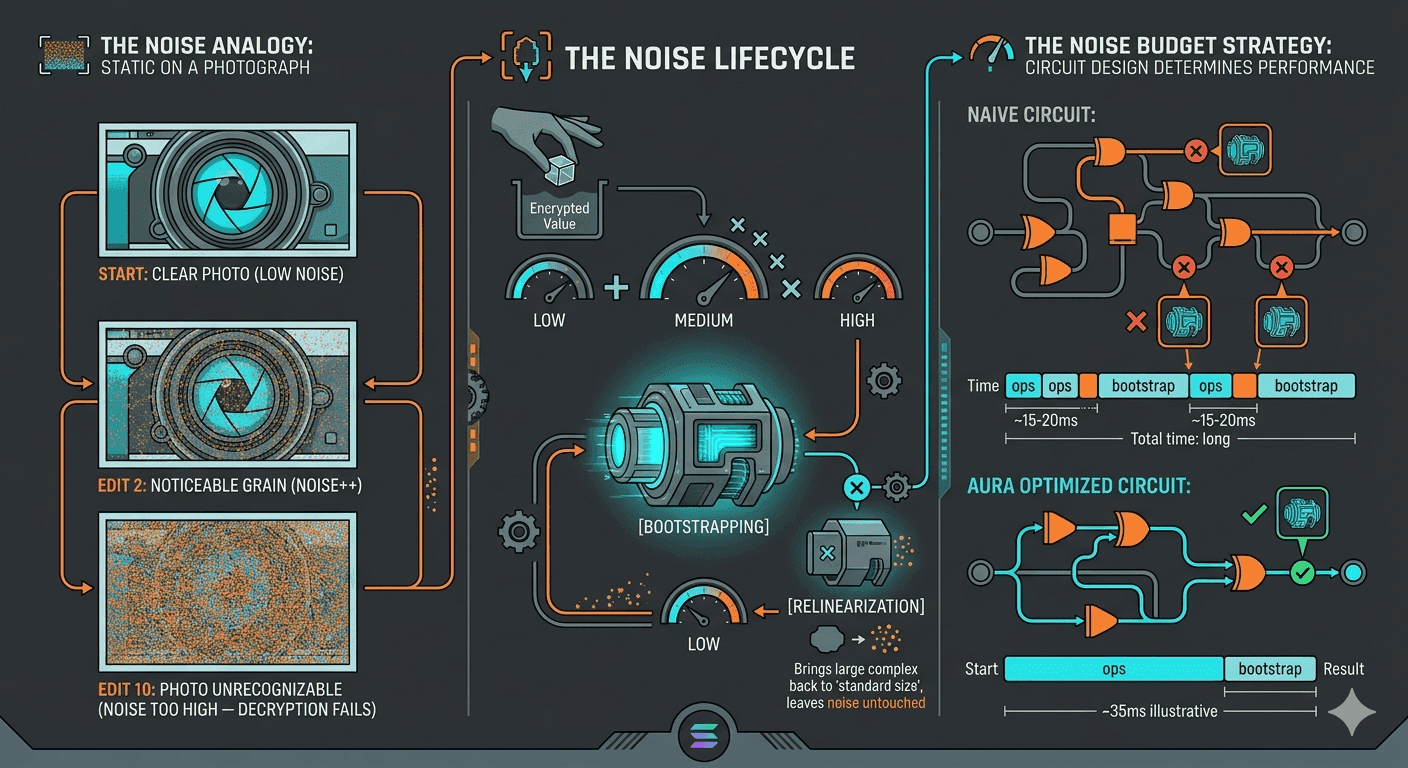
Think of taking a photo and adding random static with every edit:
Start: clear photo (low noise)
Edit 1: slight grain (noise++)
Edit 2: noticeable grain (noise++)
Edit 5: heavy static (noise++)
Edit 10: photo is unrecognizable (noise too high — decryption fails)
In FHE, the "edits" are your computation steps. The "static" is noise. And if the noise exceeds the decryption threshold, the output is garbage.
The Noise Lifecycle
Encrypt(value)
→ Ciphertext with noise level: LOW

+ Operation 1 (addition)
→ Noise level: LOW + small increment

× Operation 2 (multiplication)  ← multiplications grow noise faster than additions
→ Noise level: MEDIUM

× Operation 3 (multiplication)
→ Noise level: HIGH

[Bootstrapping] ← noise removed, fresh start
→ Noise level: LOW again

+ Operation 4 (addition)
→ Noise level: LOW + small increment
...
Relinearization: The Intermediate Fix
After a multiplication, the ciphertext grows in size — it's no longer a single polynomial pair but a larger structure. Relinearization is an operation that brings the ciphertext back to a standard size without removing noise.
Think of it like compressing a file back to a manageable size after editing. It doesn't fix the quality degradation (noise) — but it keeps the file size manageable so you can continue working with it.
Relinearization is relatively cheap compared to bootstrapping. It's typically performed after every multiplication as standard practice.
In Aura's implementation: relinearization is handled automatically by the coprocessor. SDK users don't think about it.
Bootstrapping: The Expensive Fix
Bootstrapping actually removes the accumulated noise. It's the only way to "refresh" a ciphertext and continue computation indefinitely.
The mechanism: bootstrapping evaluates the decryption function homomorphically on the ciphertext. This is a paradox — decrypting without decrypting. The decryption function produces a new, clean ciphertext with the same encrypted value but much lower noise.
The cost: evaluating the decryption function homomorphically requires hundreds of polynomial multiplications. Each of those multiplications adds noise, requires its own relinearization, and all of them need to happen within the noise budget of the current ciphertext.
This is why bootstrapping is so expensive — and why FHE's performance improvements over the past decade have been mostly about making bootstrapping faster.
The Noise Budget Strategy: How Circuit Design Determines Performance
Here's the insight that separates a naive FHE implementation from an optimized one:
You don't need to bootstrap as often if you plan your computation wisely.
Every computation has a maximum noise level before decryption fails. Call this the "noise budget." Every operation consumes some of that budget. Bootstrapping replenishes it.
The question is: how many multiplications can you do before you need to bootstrap?
Shield Swap's encrypted transit uses shallow circuits that stay within the noise budget without any bootstrapping. But for future full private computation — encrypted AMM, private order books — bootstrapping becomes necessary.
In a naive implementation of a full private swap circuit, you'd need to bootstrap four or five times. Each bootstrap: ~15-20ms. Total bootstrapping cost: 60-100ms.
Our circuit compiler reorders operations to maximize noise budget utilization before each bootstrap point. By restructuring which operations happen in what order, we get the same mathematical result with less noise accumulation — needing only one bootstrap per full private swap instead of four or five.
Visualize it:
Naive circuit:
[ops] → [bootstrap] → [ops] → [bootstrap] → [ops] → [bootstrap] → result
  ~5ms      15ms       ~5ms      15ms        ~5ms      15ms

Aura optimized circuit:
[ops ................. ops] → [bootstrap] → result
         ~20ms                    15ms

Total: ~35ms vs ~45ms (bootstrapping alone)
The difference compounds when you factor in the full computation.
How Aura Manages Noise for Solana's Constraints
Solana's 400ms block times create a constraint: the total FHE computation must fit in a latency budget that users find acceptable, while still achieving full swap confirmations within a reasonable window.
Our noise management strategy has three layers:
Layer 1: Circuit optimization. Our circuit compiler minimizes bootstrapping frequency using a modified Coffman-Graham scheduling algorithm adapted for FHE noise budgets.
Layer 2: Hybrid scheme selection. CKKS accumulates noise more slowly for arithmetic operations. By using CKKS for price math and Aura FHE's gate-level layer only for boolean checks, we extend the noise budget further.
Layer 3: Programmable bootstrapping. For full private computation, Aura FHE's programmable bootstrapping fuses the noise-refresh with a function evaluation in one step. The final slippage check in a full private swap circuit is fused with the bootstrapping operation — removing one full FHE gate from the critical path.
Result for encrypted transit (today): no bootstrapping needed, sub-second latency. For full private computation (coprocessor): one bootstrapping operation per swap, ~15ms bootstrapping cost on CPU, <0.1ms on coprocessor.
Why This Matters for Builders
If you're building on the Aura SDK, you don't manage noise budgets manually. The coprocessor and SDK handle this transparently.
But if you're designing a custom FHE application — or building circuits for a use case beyond what the SDK covers — understanding noise budgets is essential. A circuit that appears logically correct might fail in practice if noise accumulation isn't accounted for.
The Aura SDK provides a circuit simulator that estimates noise levels at each computation step.
https://github.com/aurafhe/shield-sdk/tree/shield_sdk/sdk